Title banner generated with Grok Imagine by xAI (original creation for this blog post, April 2026). All rights belong to the author for non-commercial educational and blog use.
Games are no longer just about graphics or storytelling—they are shaped by the invisible systems underneath them. From rendering engines to AI and procedural worlds, technology defines what kind of experiences are even possible. Yet despite rapid technological progress, many modern games still feel mechanically impressive but creatively empty. Our Information Technology student and game dev enthusiast Yevhenii Nazarov explores in this article how game technology has historically expanded creative freedom, and why the relationship between engineering and imagination is more important than ever.
Imagine stepping into a world that remembers you, reacts to you, and evolves because of you. That’s not just game design, that’s what happens when technology and creativity truly merge.
The gaming industry sits right at the raw intersection of art and engineering. Most people see the flash: epic stories, unforgettable characters, killer soundtracks, mind-blowing visuals, but that’s just the surface. Underneath is the invisible skeleton: rendering engines, physics solvers, networking code, animation systems, AI layers, and tools that stitch live-action video straight into gameplay. These aren’t just “tech stuff.” They literally decide what kinds of worlds we can build, how we feel inside them, and how far a designer’s wildest ideas can actually go.
I’ve been obsessed with this since I was a kid modding games, and the older I get, the clearer it becomes: when technology and creativity truly click, games stop being code and become living experiences. When they don’t… well, that’s when we end up with all the beautiful but empty shells flooding the market today. The history of games proves one thing: every major leap in creativity was unlocked by a breakthrough in technology. Let’s walk through the moments when tech actually unlocked something magical.
Carmack’s Revolution: From Flat Sprites to Real Worlds
Back in the early ’90s, games were flat. Sprites sliding across fixed backgrounds. Then John Carmack and id Software dropped the bomb. Wolfenstein 3D faked 3D with ray-casting. Doom made it prettier. But Quake was the real deal: a fully polygonal 3D world running in real time on regular PCs. BSP trees, visibility culling, dynamic lightmaps—stuff that sounds boring until you realize it let players look up, jump, fly, and explore actual volumes instead of flat stages. Suddenly designers could tell stories with verticality, atmosphere, and freedom.
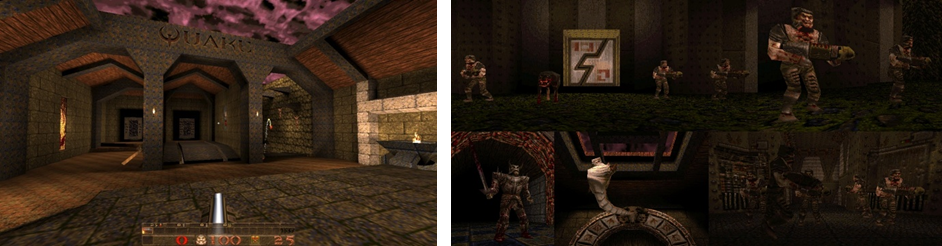
Official gameplay screenshots from Quake (1996) © id Software / Bethesda Softworks. Source: official id Software archive (Quake Wiki + press kit). Fair use for educational and review purposes.
Carmack didn’t stop there. Years later in Rage he invented MegaTextures—one absurdly huge texture (128,000 × 128,000 pixels, gigabytes of data) painted across the entire level. No more repeating bricks. The engine streamed only the bits you could see, using clever clipmapping and virtual texturing. Artists could literally draw unique details on every surface like an infinite canvas (Devcry, 2011). That idea is still alive today in Unreal Engine 5’s virtual texturing. One technical hack, and whole new scales of believable worlds became possible.
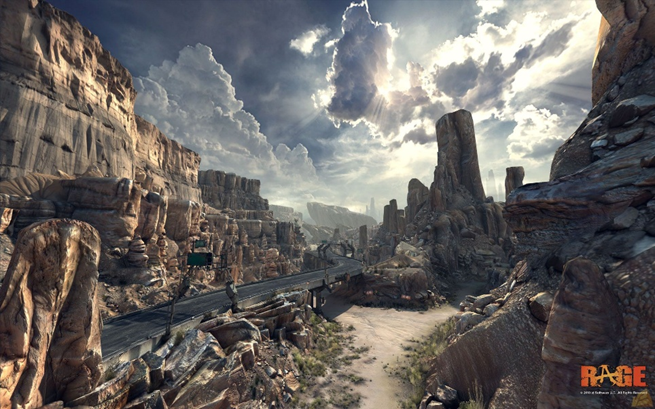
Official screenshot from Rage (2011) © id Software. Source: official press release id Software / Bethesda (2011). Fair use for educational and review purposes.
Epic Games took the same crazy idea and pushed it to the limit in Unreal Engine 5 with Nanite — a virtualized geometry system that can render billions of triangles without breaking a sweat — and Lumen, real-time global illumination that reacts instantly to every light change and explosion. What started as Carmack’s gigantic texture hack has now become the foundation for truly infinite, unique worlds (Epic Games, 2020). Tech keeps evolving, and creativity just keeps getting more space to run wild. Carmack didn’t just improve graphics — he redefined what game worlds could be.
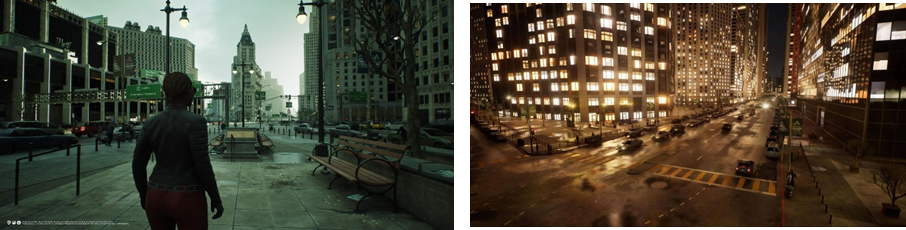
Official demo screenshot from The Matrix Awakens (Unreal Engine 5 demo) © Epic Games / Warner Bros. Source: official Unreal Engine website (unrealengine.com). Fair use for educational and review purposes.
When Tech Becomes the Story: Remedy’s Northlight Engine
Graphics are cool, but the real mind-blow is when the engine starts carrying the narrative. Finnish studio Remedy has been nailing this for years.
Max Payne’s bullet-time wasn’t just a slow-mo effect—it was the entire simulation (physics, animation, AI) carefully time-scaled while keeping your inputs snappy. It felt like a movie you controlled. Then they built their own Northlight engine for Alan Wake, Quantum Break, Control, and especially Alan Wake II. Data-oriented ECS for buttery-smooth multi-core performance, GPU-driven rendering, real-time ray tracing, and the killer feature: live-action video composited straight into gameplay.
In Alan Wake II the actors’ footage isn’t locked in a cutscene. It reacts to in-game lights, shadows, fog, and physics in real time. The result? You don’t watch the story—you live inside it. Cinema and interactivity stop fighting each other and start dancing. Here, technology doesn’t support the story, it becomes the story (Remedy Entertainment, n.d.).

Official gameplay screenshot from Alan Wake II © Remedy Entertainment / Epic Games. Source: Remedy Games official press kit. Fair use for educational and review purposes.
AI That Actually Creates Drama: Nemesis and Beyond
Sometimes the coolest tech isn’t about pixels. Instead it’s about making the world feel alive. Monolith’s Nemesis System in Shadow of Mordor and Shadow of War is still one of the best examples. Every orc has memory, personality traits, rivalries, and ambitions. You humiliate one? He comes back scarred, promoted, and trash-talking you. The system generates personal stories without a single hand-written quest. Procedural, persistent, and insanely replayable (Kotaku, 2021).

Official screenshot from Middle-earth: Shadow of Mordor / Shadow of War © Monolith Productions / Warner Bros. Source: official Warner Bros. press kit. Fair use for educational and review purposes.
You see the same spirit, scaled up, in Warhammer 40,000: Space Marine 2. Saber’s horde AI throws hundreds of enemies at you using smart flocking, layered pathfinding, and adaptive behavior. It never feels scripted, it feels alive (Focus Entertainment, 2024).

Official gameplay screenshot from Warhammer 40,000: Space Marine 2 © Saber Interactive / Focus Entertainment. Source: Focus Entertainment official press kit (2024). Fair use for educational and review purposes.
This idea of systems creating emergent stories evolved further in games like Minecraft. There’s no scripted narrative at all, instead just a set of interacting systems: physics, crafting, world generation. Yet players create their own stories, cities, and entire worlds. It’s pure systemic creativity. The game becomes a platform for imagination rather than a fixed experience.
Indie Magic: Valheim Shows You Don’t Need a AAA Budget
Not all breakthroughs come from massive studios. Valheim, a tiny team, proved you don’t need millions to create something that feels alive. Seed-based procedural worlds, tight physics-driven building, and rock-solid networking that just works in co-op. No ray tracing, no cinematic cutscenes, just smart systems that make every session feel unique and organic. Pure proof that clever tech and clear vision beats brute-force budgets every time.
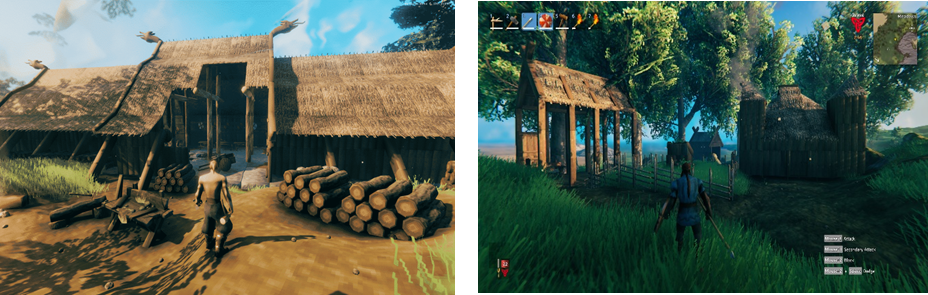
Official screenshot from Valheim © Iron Gate Studio / Coffee Stain Publishing. Source: official valheimgame.com press kit.
Fair use for educational and review purposes.
A similar philosophy can be seen in No Man’s Sky. Entire galaxies are generated mathematically, yet filled with handcrafted details and continuous updates. It shows how technology can grow alongside creativity, not just at release, but for years after. It’s proof that innovation isn’t about budget—it’s about systems and vision.

Official screenshot from No Man’s Sky © Hello Games. Source: Official Hello Games Gallery (nomanssky.com/press + press releases). Fair use for educational and review purposes.
The Dark Side: When Tech Stops Serving Creativity
But here’s the part that genuinely worries me. We have more powerful tools than ever. Still so many big games feel… hollow. Stunning trailers, ray-traced everything, but the physics are weak, the worlds feel static, and the AI is just filler. Studios chase visual polish and “live-service” retention metrics instead of inventing new ways to play.
Generative AI is everywhere now, which is great for speeding up assets, but when it becomes a crutch you get the same enemy patterns, same quests, same empty open worlds. Even worse: engine limitations can straight-up murder creativity. Picture this: you’re making a simple 2D game and you want players to craft fully custom enchanted items. But the entire item system is hardcoded. Boom. Your ideas hit a wall.
That pure “demiurge” feeling, when you create a world and then live in it, gets crushed before it even begins: open worlds filled with repetitive fetch quests, NPCs with no real memory, and physics systems that barely interact with the player. I felt that magic as a kid with Warcraft 3’s World Editor. I’d spend days building worlds, scripting heroes, creating campaigns… then actually playing them. That wasn’t just playing, instead it was learning to think like a creator (Hive Workshop, n.d.).
Today I’m studying graphics, engines, and code, and I see the same power in Carmack’s tricks, Remedy’s pipeline, and procedural systems. But I also see the industry drifting toward safe, formulaic design. And honestly — it makes me anxious as hell.
So What Now?
Look, technology isn’t the villain. It’s the most powerful creative multiplier we’ve ever had. Students learning shaders and C++ today have tools Carmack could only dream of. Indie devs using Unity or Godot can build worlds that once required entire AAA studios.
The difference is simple: tech has to serve the vision, not replace it.
So if you’re a student, a future dev, or just someone who still gets that rush when a game feels truly alive, don’t wait. Grab the tools. Break a few rules. Build something impossible. Because the next revolution in games won’t come from better graphics, it will come from someone brave enough to use technology in a completely new way.