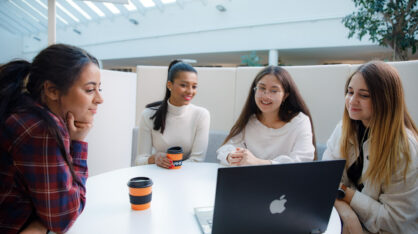
Few weeks back, students from Vaasa University of Applied Sciences (VAMK) and Kauno Kolegija University of Applied Sciences came together for a collaborative international learning experience focusing on one of today’s most defining global themes sustainability. This time the focus was on it’s impact on supply chains and student life. The session was organised as a COIL (Collaborative Online International Learning) activity, where students and teachers from different countries join forces in a shared virtual classroom. This format allows students to experience international teamwork, intercultural communication and joint problem-solving, all within the context of real-world global issues.
The lecture centred on the role of sustainability in supply chain management and logistics. Students often encounter the concept of sustainability in environmental discussions, but sustainability within supply chains is often a more complex field. During the session, we explored how companies today face increasing pressure to manage their environmental impact, ensure ethical sourcing, improve transparency and adopt circular approaches that reduce waste. The classroom discussion highlighted how these shifts are driven not only by regulatory demands but also by customer expectations, global trends and the rapid digitalisation of logistics networks.
What made the lecture especially engaging was the connection to students’ own lives. Although many initially viewed supply chains as distant business operations, it quickly became clear that every student is part of multiple supply chains every day. From the food they consume and the clothes they buy to the ways they commute, collaborate and use digital tools, the logistics of student life are well within the field of sustainability. This realisation helped students identify their personal role in larger systems and understand how their choices feed into wider economic and environmental impacts.
Following the lecture, students were grouped together in mixed teams for an interactive assignment titled “Sustainable Student 2030.” Their task was to envision what it will mean to be a sustainable student in the year 2030 and to describe how individuals can act responsibly within an increasingly global and digital world. Students were encouraged to think broadly, creatively and realistically with few simple questions What does sustainable living looks like for a student? How can international cooperation make student life more responsible? And What technologies will support these changes?
The resulting discussions were lively and filled with refreshing ideas. Some groups imagined the Sustainable Student 2030 as someone who manages their personal carbon footprint through conscious daily habits such as low-emission commuting, responsible consumption and reducing waste. Others emphasized the importance of social sustainability by highlighting well-being, inclusion, cultural understanding and ethical behaviour as essential qualities of the student of the future. Many groups also identified digital tools as enablers of sustainability, envisioning smarter campus logistics, AI-supported learning, digital workflows that reduce unnecessary materials and more transparent communication systems that help students act responsibly.
One theme was shared across all groups: sustainability is not something that happens at corporate or governmental levels. It is fundamentally shaped by individuals making informed decisions. Students recognised that their own actions contribute to the sustainability of their communities, their universities and the societies. The “Sustainable Student 2030” was not described as a distant, idealistic figure, but as someone highly achievable. A student who is aware, cooperative, resourceful and reflective.
This COIL session once again demonstrated the value of international collaboration in higher education. Learning from and with peers from another country encourages students to compare perspectives, listen actively, communicate clearly and appreciate different cultural approaches. Instead of viewing sustainability through a single national lens, students had the opportunity to explore global challenges collectively and develop solutions that draw on diverse ideas.
For both VAMK and Kauno Kolegija, this lecture marked another successful step in creating these international learning environments where students are encouraged not only to understand global issues but to imagine themselves as future professionals capable of addressing them. The conversations generated during the session showed that students are ready to approach sustainability not just as a theoretical concept, but as a mindset and a practical way of navigating everyday life.
As we continue to build our COIL collaborations, we look forward to providing more opportunities for students to connect, exchange ideas and actively shape a more sustainable future. The creativity and maturity the students displayed in designing their visions for the Sustainable Student 2030 suggest that the next generation is more than prepared to meet the challenges ahead and to contribute positively to a world where responsible choices matter more than ever.