Introduction
Engineering projects increasingly rely on configurable systems that contain large numbers of parameters and dependencies. In medium-voltage switchgear projects, engineers must define electrical ratings, cubicle structures, protection components, and other configuration data before engineering documentation can be generated. The quality of this configuration data directly affects the quality of downstream engineering outputs.
This development project was carried out in cooperation with VEO Ltd. as part of Kostiantyn Chygrin’s bachelor’s thesis, supervised by Anna-Kaisa Saari. It focused on improving how configuration data is prepared before integration with EPLAN Engineering Configuration (EEC). The main objective was to reduce configuration errors, improve data consistency, and support a more structured engineering workflow through a dedicated frontend configurator prototype.
Challenges in Existing Engineering Workflows
Analysis of the existing workflow revealed several challenges. Configuration data was often handled manually across multiple tools, making it difficult to maintain consistency throughout the process. Engineers worked with many interdependent parameters, where a change in one value could affect multiple other selections.
Another important issue was the timing of validation. In many cases, configuration problems became visible only during later stages of the workflow, such as documentation generation or engineering automation. As a result, engineers often needed to perform additional manual verification and correction work.
These observations highlighted the need for a solution that could improve data quality earlier in the configuration process.
Proposed Solution
To address these challenges, a frontend engineering configurator was developed. The prototype acts as a pre-processing layer between engineers and EPLAN EEC. Rather than replacing the engineering system itself, the configurator focuses on improving the quality and consistency of configuration data before export.
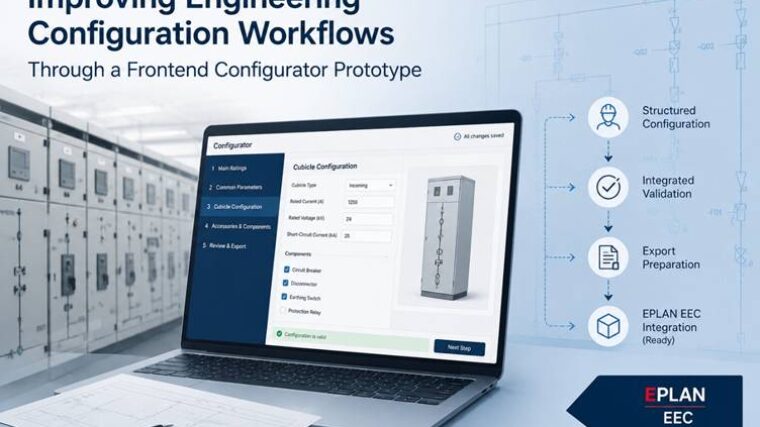
The system guides users through a structured workflow and integrates validation directly into the configuration process. This shifts error detection from later engineering stages to the point where data is initially defined.
The overall approach combines user interaction design, centralized data handling, validation mechanisms, and export preparation into a unified workflow.
Technical Implementation
The prototype was implemented as a client-side web application using React and TypeScript. A centralized configuration model was implemented using Zustand state management.
The centralized state model acts as a single source of truth for the entire configuration. User interface components, validation mechanisms, export functions, and preview functionality all operate on the same shared configuration state. Such architectural approaches support consistency and maintainability in complex software systems (Bass, Clements & Kazman, 2013).
An important aspect of the implementation was handling parameter dependencies. Rather than using a separate industrial rule engine, the prototype implements dependency-driven behaviour through centralized state management, validation logic, conditional parameter visibility, and parameter normalization mechanisms.
For example, enabling certain engineering components activates additional required parameters. Similarly, selected cubicle types determine which parameter groups are available and which values are considered valid. The system also normalizes configuration structures by removing parameters that are not relevant to the selected configuration context.
This approach allows the configurator to support realistic engineering dependency scenarios while keeping the implementation manageable within the scope of a bachelor’s thesis.
Step-Based Workflow and Validation
The user interface follows a step-based workflow that reflects the engineering configuration process. Instead of displaying all configuration parameters simultaneously, the system guides users through a sequence of logical stages. Guiding users through structured workflows supports effective and efficient task completion, which are key objectives of usability according to ISO 9241-11 (2018). The workflow includes: main electrical ratings, common configuration parameters, cubicle configuration, accessories and additional components, final review and export preparation.
Navigation between steps is connected to validation results. Users can move freely through the workflow, but progression is restricted when critical validation issues are detected.
Validation operates continuously during user interaction. The system checks configuration completeness, parameter dependencies, logical consistency, and export readiness. Validation feedback is displayed directly within the interface, allowing users to identify and correct issues at an early stage.
This approach reduces the likelihood of incomplete or inconsistent configurations progressing further into the engineering workflow.
Export Preparation and Integration Readiness
Another important aspect of the prototype is export preparation. The system transforms user-defined configuration data into structured export payloads suitable for engineering workflows.
The prototype supports multiple export formats, including JSON, CSV, XML, and IMX-compatible structures. A dedicated mapping layer separates internal user-oriented parameter names from external integration-oriented identifiers. This separation improves maintainability and allows integration requirements to evolve without affecting the user interface.
Because direct integration with EPLAN EEC was outside the scope of the project, a mock integration layer was implemented. This layer simulates export verification and integration behaviour, allowing the complete workflow to be tested without requiring access to a live engineering environment.
Results and Evaluation
The completed prototype demonstrates how a frontend-based configuration system can improve engineering data preparation. The centralized configuration model supports consistent handling of interdependent parameters, while integrated validation enables earlier detection of configuration issues.
Initial usability evaluation indicated that users found the workflow logical and easy to follow. Participants particularly valued the visibility of validation feedback and the ability to identify configuration issues before export.
The evaluation also highlighted opportunities for future improvements, including clearer descriptions for certain parameters and additional guidance in more complex configuration scenarios.
Although full integration testing with EPLAN EEC was not available during the project, the implemented prototype successfully demonstrated the feasibility of the proposed approach and validated the overall workflow concept.
Conclusion
The project shows that user interface design can have a direct impact on engineering workflow quality. By combining structured interaction, centralized configuration management, dependency-aware validation, and export preparation, the prototype improves the consistency and reliability of engineering configuration data.
The work demonstrates that validation should not be treated as a final verification step but as an integrated part of the configuration process itself. Early validation is a well-established software engineering practice that helps reduce errors and rework later in the development process (Sommerville, 2016). Moving validation earlier in the workflow helps reduce errors, improve transparency, and support more reliable engineering automation.
The project also provided practical experience in applying software engineering, user interface design, and engineering data modelling within an industrial development environment. As engineering systems continue to become more configurable and data-driven, approaches that combine usability and engineering validation are likely to become increasingly important in industrial software development.