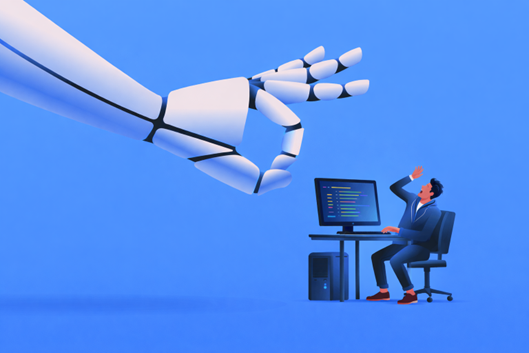
Just a few years ago, writing code was considered an exceptionally human skill. Today, it is no secret that AI influences nearly every stage of the software development process. Artificial Intelligence has rapidly moved from a futuristic concept to an everyday tool used by millions of developers. From code generation to debugging, AI is transforming in real time how software is built. Such rapid change inevitably leads to concerns about the future of the profession. So, is the role of software developers truly on the verge of extinction?
Before AI: What Developers Used to Do
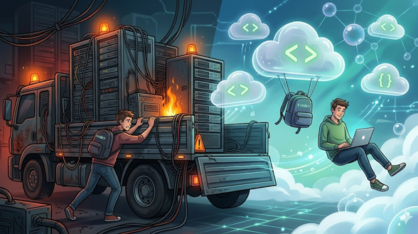
To understand how AI has been transforming the profession, we need to look first at what traditional role of developers involved before the widespread AI adoption. In that context, developers were responsible for the entire software development lifecycle, from initial idea to deployment and maintenance. Building software was fully human-driven; developers relied heavily on their own knowledge, familiarity with tech stack, problem-solving skills. If you did not know something, you had to look through documentation or ask for guidance on forums like StackOverflow. There were no instant answers, just continuous learning.
As a result, the learning curve was steep, making it difficult for beginners to become productive early on. Gaining expertise took time, practice, and persistence, gradually leading to pattern recognition and independent problem-solving. Even then, reaching the point of confidently building solutions on your own was a long and often bumpy journey.
This also affected the pace of development. Writing code itself was significantly slower before AI. Everything had to be built manually, line by line, with no tools to generate complete solutions from a prompt. As a result, development speed came from years of practice rather than instant assistance like we have today.
On top of that, a large portion of a software developer’s work consisted of repetitive tasks and boilerplate code. Most projects tend to follow similar patterns: implementing standard CRUD operations, configuring environments, and integrating APIs. In the absence of intelligent automation, each step required significant amount of manual effort. While tools like IDEs, debuggers and linters improved productivity making work easier, they didn’t fundamentally reduce the level of human involvement.
Another major challenge was debugging. Debugging, in particular, was a time-consuming task of its own. With only logs, print statements, and debuggers at your disposal, it was not unusual to spend hours tracking down even the most subtle bugs.Ultimately, software was very much a product of its author, you were fully responsible for both the process and the outcome, and the results directly mirrored your level of expertise and experience. This naturally drove continuous learning and skill development.
How AI is Changing Software Development
Today’s software development workflow has little in common with the past. AI tools are now deeply embedded in everyday workstreams, impacting everything from automation and debugging to testing, and consulting. Using AI is no longer optional, many employers now expect developers to have strong AI prompting skills. According to a 2024 Work Trend report by Microsoft, 66% of leaders say they would not hire someone without AI skills, highlighting how quickly these expectations are becoming the industry standard.
So where does AI actually make the biggest difference?
The most noticeable shift, still very much in progress, is now in how code is produced. Developers are no longer writing everything from scratch; instead, they collaborate with AI systems that can generate large portions of code. What started as small suggestions from conversational assistants has evolved into AI coding agents capable of handling significant parts of a codebase, leaving developers to focus primarily on reviewing and refining outputs.
This change is already visible in practice. For example, Boris Cherny, the creator of Claude Code, shared that during one month he did not open an IDE at all, with AI generating nearly all of his code contributions (Cherny, 2025). At the same time, leaders of major AI companies, such as Anthropic’s CEO Dario Amodei, suggest that AI may soon be responsible for the vast majority of code written. These perspectives reflect a broader belief that software engineering is undergoing a fundamental transformation.
AI excels at routine programming tasks. Automation, refactoring, writing tests, and generating boilerplate code can now be delegated almost entirely to AI tools such as Claude Code or GitHub Copilot. These tools integrate directly into development environments, suggesting fixes, improvements, and even complete implementations in real time. As a result, development becomes significantly faster and more efficient.
One of the major improvements in modern AI tools is their ability to understand and retain context. Earlier systems provided generic or incomplete answers that required heavy adjustments. Today, AI can analyze large parts of a project and generate tailored solutions, sometimes without requiring the developer to write any code manually at all. Debugging has also been significantly improved. Rather than spending hours tracing issues, developers can rely on AI to quickly identify bugs and propose fixes.
Beyond coding, AI supports other important aspects of development. It can generate documentation, write comments, and explain existing code, making projects easier to maintain and understand. Additionally, AI serves as a learning companion helping developers quickly grasp new technologies, frameworks, or concepts through explanations and examples.
Overall, the role of the developer is changing. Writing code by hand is no longer the primary activity. Instead, developers describe problems, guide AI systems, and validate its outputs. A typical modern workflow reflects this shift: a developer prompts an AI to generate code, reviews the output, runs tests, and then refines the solution through additional prompts. AI is no longer just a tool, it has become an integral part of the development process.
The Risks of AI in Development
However, AI is not flawless. While it offers significant advantages, it also introduces a range of risks that cannot be ignored.
One major concern is security. AI systems can learn from user inputs and retain data for future outputs, which creates potential security risks for companies when sensitive data is involved. Not everything can be safely shared with AI tools, as confidential data, trade secrets, internal code, or private information could be accidentally exposed or reused in other contexts and in unintended ways.
Another limitation comes from the data AI is trained on. Most models rely heavily on publicly available code and datasets, while not all code, including many internal or private resources, is accessible for training. As a result, the solutions generated by AI are not always the most optimal or aligned with real-world production standards. This can lead developers to rely on AI too much, overestimate its accuracy, and become overly confident in its suggestions, which may gradually weaken their own skills expertise.
At the same time, AI struggles with more complex, ambiguous or poorly-documented problems, where human judgment and experience remain essential. While it performs well on structured and repetitive tasks, situations that require deep understanding, reasoning, architectural thinking, or creative problem-solving still depend on human expertise. AI does not truly “think” or innovate. Instead it generates outputs based on patterns in existing data and probabilities, rather than producing genuinely new ideas.
Finally, AI is prone to hallucinations. It can produce incorrect or misleading code, especially when dealing with unfamiliar tasks or vague requirements. More importantly, these limitations highlight a fundamental constraint: AI cannot operate independently without clear instructions. Human supervision remains essential to evaluate outputs and ensure that the generated solutions are correct and meaningful.
What This Means for Future Developers?
These challenges are not just about the technology itself – they directly shape how developers work, learn, and adapt to this new reality.
AI can be especially useful early in a career. It can act as a personal tutor, helping to understand concepts, explain lines of code, generate examples, and learn faster than ever before. Instead of spending hours searching through documentation, students can get instant explanations tailored to their level.
At the same time, this creates a paradox. Since AI can handle much of the everyday work of an entry-level software developer, it reduces the need for junior developers and decreases the number of such positions available. Companies are becoming less willing to hire interns or open junior roles. Tasks that were once essential for learning and gaining experience are now automated, making it harder for beginners to enter the industry and stand out.
As a result, the role of developers is gradually shifting. Developers move from manual code writing to supervising and guiding AI systems. This shift can be compared to the industrialization period: machines replaced manual workers, but also created new roles and responsibilities. Similarly, AI is not simply replacing programmers, but transforming their work by moving the focus toward more challenging tasks that require creativity, reasoning, and a broader perspective.
With the wider adoption of AI agents, developers are now able to complete tasks that previously took days or even weeks within hours. At the same time, there is less need to deeply specialize in a single tech stack. Developers with different backgrounds can now solve problems even in unfamiliar areas, relying on AI to handle implementation details with surprising accuracy.
Because of this, it becomes less common to hire narrowly specialized roles. Instead, it is more valuable to have engineers who can unblock themselves across the stack using AI tools. There is less demand for “just coders” and more demand for well-rounded software engineers with broader technological awareness and the ability to think strategically.
Therefore, the value of software developers is shifting away from mastery of specific technologies toward deeper cognitive and strategic skills. These include strong problem-solving skills, the ability to understand complex systems, and the capacity to see the big picture when designing software. Equally important is the ability to work with ambiguous requirements, poorly documented systems, and non-standard situations where creativity and critical thinking are essential.
Another important skill that emerges in this new environment is the ability to effectively communicate with AI systems. Prompting AI is far from trivial. It is not just typing a request and getting a perfect answer. It requires clarity, structure, and iteration. Developers increasingly need to understand and work with the broader AI ecosystem, making AI prompting a real skill that needs to be learned and refined.
Conclusion
What this all comes down to is simple: AI is not replacing software developers, but it is fundamentally reshaping the way they work.
AI cannot operate autonomously. It cannot handle complex requirements, strategic thinking, or deeply contextual decisions. It does not truly understand the domain, the business, or the environment in which the software is built. It does not grasp the roadmap, the constraints, or the broader goals behind the system. Instead, it relies entirely on patterns and instructions provided to it.
Rather than replacing expertise, AI enhances what developers already know. By focusing on skills that AI cannot replicate: critical thinking, system design, creativity, and the ability to deal with ambiguity, developers can remain relevant in this evolving landscape. Ultimately, the future of software development will depend not only on what AI can do, but also on how developers choose to use it.