A regional conversation about people
YoungTalk was born from a changing reality in Vaasa and Ostrobothnia. An ageing population, a shrinking workforce and the growing importance of international expertise have raised an increasingly relevant question: how can a region attract people and create the conditions for them to build meaningful lives?
The initiative was started by Marja-Riitta Vest, with the goal of developing Vaasa and Ostrobothnia as internationally interesting, open and vibrant regions where young and international experts can build their future.
After seven editions, the original bottom-up approach remains visible. Young and international people are not simply subjects of discussion. They are invited to share experiences, question existing practices and develop solutions together with companies, educational institutions, public organisations and regional decision makers.
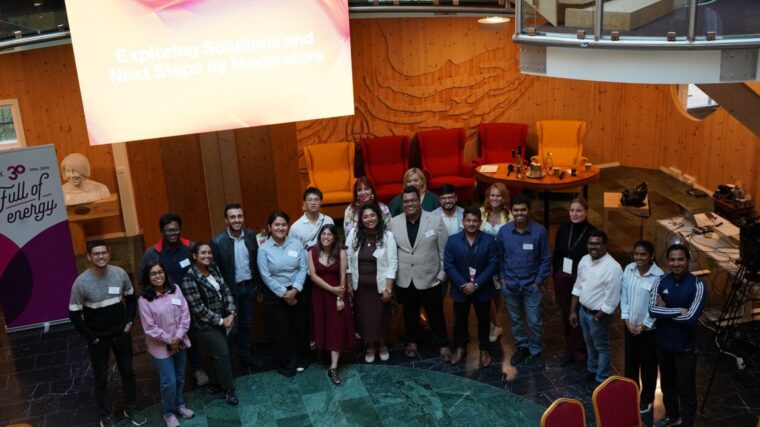
I experienced this from a slightly unusual position at YoungTalk26: the moderator’s seat.
Rather than simply listening to presentations, I had the opportunity to watch the conversation move from the stage to the audience, from individual experiences to collective discussion and finally towards possible solutions.
From attracting talent to creating reasons to stay
Minister Joakim Strand set the tone for the evening by shifting attention from investments and infrastructure towards the people behind regional development.
His message was particularly relevant to the rest of the programme: attracting talent is only the first step. The longer-term question is whether people choose to stay, build careers, create networks and become part of the community.
This connects with research on belonging. People have a fundamental need to form and maintain meaningful interpersonal relationships (Baumeister & Leary, 1995). Relatedness is likewise identified as one of three basic psychological needs associated with motivation and well-being (Ryan & Deci, 2000).
That made Katarina Hellén’s (Research Manager, VILPE) presentation, Cracking the Code of Belongingness, particularly relevant.
Her question was simple: What makes people stay?
A job can bring someone to a place. It does not necessarily make that place home.
Belonging can develop through relationships, trust, social networks and everyday experiences of being accepted and valued. For employers, this may involve ordinary actions: inviting a new colleague for lunch, explaining unwritten workplace practices, helping people build connections and supporting newcomers beyond their immediate job.
Belonging is therefore not simply a benefit added to employment. It can influence whether people see a future for themselves in a region.
Careers are built through opportunities
In his keynote speech, Pathways to Potential: How Regional Actors Unlock Talent Growth, Kenneth Engblom, Vice President Europe and Africa at Wärtsilä, brought a different perspective through his own career journey
His path from engineering to international leadership involved different roles, countries and responsibilities. His message to young talent was practical: be curious, learn quickly, build relationships, volunteer, accept international experience and be willing to say YES to opportunities.
For someone trying to establish a career in a new country, that message matters.
The first opportunity can be the hardest to obtain. Without local experience and networks, it can be difficult even to reach the first conversation with an employer.
Yet once an opportunity is created, experience can lead to relationships, relationships can lead to new opportunities and careers can begin to develop.
This is where regional actors have a role. Talent retention cannot be separated from the question of access to opportunity.
Diversity becomes valuable when people can contribute
In his presentation, Inclusion as a Strategy: Turning Diversity into Regional Success, Keimo Kalliosaari, CEO of Leinolat Group, showed what this can look like from an organisational perspective.
Leinolat Group has grown while recruiting people from different countries and backgrounds. Kalliosaari described three values at the centre of the company culture: teamwork, trust and transparency.
What stood out was that diversity was not presented simply as a target or policy.
It was connected to how the organisation works.
Research makes a similar distinction between diversity and inclusion. Diversity concerns who is present, while inclusion involves experiencing both belonging and the ability to maintain one’s distinctiveness within a group (Shore et al., 2011).
That distinction matters for organisations.
A workplace can become more diverse without necessarily becoming more inclusive.
When people can contribute their knowledge, experiences and perspectives, diversity can become part of how organisations solve problems, understand markets and develop new ideas.
When the audience becomes part of the programme
The most important shift happened when the conversation moved from the stage to the tables.
Together with my fellow moderators Neha Anand, Chippy Chandra Pillai and Catherine D’Costa, I helped lead the co-creation session around three themes:
- Unlocking the code of regional success.
- Turning inclusion into action.
- Recognising hidden potential.
The format was deliberately participatory. Instead of asking the audience simply to listen, we asked them to reflect, discuss and propose solutions.
The Mentimeter results gave us a snapshot of what the room was thinking.
When asked what makes a region successful for talent, the strongest themes included opportunities, collaboration, inclusion, culture, growth, acceptance and openness. When asked about the biggest challenge Vaasa needs to address to attract and retain talent, building stronger connections between talent and companies received the strongest support.
The numbers were interesting.
The pattern was more interesting.
The conversation repeatedly returned to connections: between talent and companies, education and working life, international professionals and local networks.
This is where the idea of co-creation became more than an event format. Different people were bringing different experiences to the same question.
Inclusion needs psychological safety
Under the theme Turning Inclusion into Action, Sanna-Mari Kaakinen, Sustainability Manager at ABB Smart Power, described inclusion as something that can create belonging and psychological safety, opening space for innovation, motivation and creativity.
That connection has a strong basis in organisational research. Psychological safety refers to a shared belief that a team is safe for interpersonal risk-taking and research has linked it with learning behaviour in teams (Edmondson, 1999).
For me, this was particularly relevant to the co-creation session itself.
People need to feel sufficiently safe to say something that may not be perfect.
They need to be able to disagree.
They need to ask questions.
They need to feel that their contribution will be taken seriously.
Our audience responses reflected this. When asked what makes people feel included, the answers included communication, respect, equal opportunities, listening, trust, being accepted as oneself and having the opportunity to contribute.
Inclusion therefore becomes something people experience through everyday interactions, not only through organisational policies.
Recognising potential beyond the CV
The third theme (Recognising the Hidden Potential), led by Johnny Lindqvist, CSO & Partner at TK Engineering, challenged another common assumption.
Small companies may have strong technology, products and engineering competence without having dedicated recruitment teams. They may need new business and new capabilities without having a formal position ready to advertise.
Johnny offered a provocative alternative to the traditional job-seeking question:
Instead of asking, “Do you have a job for me?” ask, “Could I help you find new business?”
The audience discussion around hidden potential supported this broader view of talent. Participants identified qualities such as willingness to learn, resilience, consistency, adaptability, different perspectives, empathy, creativity and potential as strengths that can be overlooked when talent is evaluated mainly through traditional qualifications and career history.
This suggests a different question for employers: Not only “Who fits the position we have?” But also: “What could this person contribute that we have not yet considered?”
That shift could be particularly relevant for international talent, whose previous experience may not always fit neatly into local recruitment systems.
From discussion to action
One of the strongest parts of YoungTalk26 was that the conversation did not stop at identifying problems.
The tables were asked to propose practical solutions.
Ideas included stronger networking opportunities, better access to language learning, project-based pre-employment opportunities, company-led learning programmes and ways for international talent to demonstrate what they can contribute. One recurring idea was to evaluate people through what they can actually do rather than only through what their CV says they have done.
This connects with a broader view of integration. Ager & Strang (2008) describe integration through several connected dimensions, including employment, housing, education, rights, social connection and the structural conditions that enable people to participate in society.
Employment matters.
But employment alone is not the whole story.
What stays with me from the moderator’s seat
At the end of the evening, the four moderators came back together for the final discussion.
Chippy reflected on how being supported during his first experience of hosting helped him feel a sense of belonging.
Katherine emphasised the need to continue the conversations and turn ideas into action.
Neha shared how one invitation had led to another connection, and another, gradually helping Vaasa become home.
From my perspective, the day brought one idea into focus: The potential is already here. The question is whether we create the connections and opportunities that allow it to contribute.
That is perhaps the real challenge for Vaasa and other regions facing similar demographic and workforce changes.
It is not only about attracting people.
It is about creating an environment where people can contribute, connect, belong and grow.
Building the next conversation
YoungTalk26 was hosted at Wasa Innovation Center, a space that has supported the event for seven years. A sincere thank you belongs to Sture Udd, the owner of Wasa Innovation Center, for continuing to provide the space where this conversation has taken place year after year.
I am grateful to Kartik Sharma, the project manager who helped bring the many moving parts of the event together and to Malin Wälitalo-Palo, my colleague and career advisor, whose support has been part of my own journey in Vaasa.
Most of all, thank you to Marja-Riitta Vest for starting YoungTalk and keeping the conversation alive for seven consecutive years.
The event’s bottom-up approach remains relevant because regional challenges cannot be solved by one group alone.
Companies need talent.
Talent needs opportunities.
Universities need stronger connections with working life.
Communities need connections between people.
And regions need people who choose not only to arrive, but to build something here.
YoungTalk26 reminded me that these are not separate conversations.
They are one conversation.
How do we create a place where people can see a future for themselves?
Perhaps the answer starts with giving people a seat at the table.
And then actually listening when they speak.
About the author
Ataur Rahman is a master’s graduate in Industrial Engineering and Management from the University of Vaasa, Finland. Originally from Bangladesh, he has been involved in university activities, community initiatives and projects connecting international talent with local organisations and communities.
He was one of the moderators of YoungTalk26, where he facilitated discussions on regional development, talent, inclusion, belonging and the role of international professionals in shaping the future of the Vaasa region. His interests include belonging, inclusion, international talent and community building. He has also delivered a TEDx talk on belonging, drawing on his experience of building a life in Finland.
For this article, he reflects on YoungTalk26 from the moderator’s perspective and considers what
the event revealed about creating a region where people can contribute, connect, belong and grow.