Leadership paradigms and expectations in working life have evolved significantly since the early 20th century, shifting from hierarchical models toward more diverse, inclusive, and complex structures (Viitala, 2021; Lehto, 2023). Today, organizations, leaders, and employees alike are expected to demonstrate flexibility and the ability to adapt to change (Peltonen, 2007; Lehto, 2023).
Modern working life is often characterized by rapid changes, evolving job roles and organizational structures, as well as increasing external uncertainty. This means that both leaders and employees must be capable of responding quickly to dynamic environments (Peltonen, 2007; Lehto, 2023). To succeed under these conditions, organizations need strong and effective leadership.
But what does good leadership mean? First and foremost, leadership is about leading people. It emphasizes interaction, trust, and understanding of individual needs. A good leader motivates and inspires their team to achieve the best possible results while maintaining a strong foundation of trust.
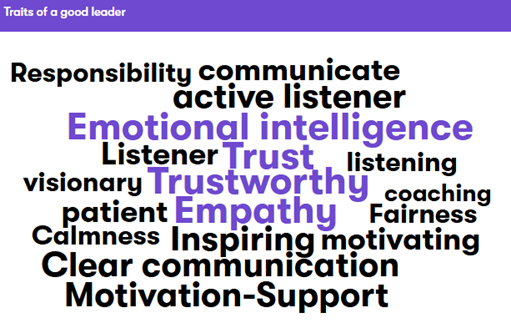
Within the APPROACH project, one area is Individuals’ development, which includes a workshop on leadership skills. The workshop Leadership Skills: How to Lead People provided valuable insights into how the Approach project partners perceive good leadership in practice. During the session, the workshop participants were asked to reflect on the question: “What traits come to mind when you think of a good leader?” Their responses were visualized in a word cloud, highlighting the most valued leadership qualities.
The most prominent traits identified were emotional intelligence, trust, empathy, and trustworthiness. These findings indicate that the workshop participants see strong interpersonal skills as the foundation of effective leadership. A good leader is not only competent but also emotionally aware, able to understand others’ perspectives, and capable of building genuine trust within a team.
However, the workshop results also highlight that good leadership is far from easy. Based on the participants’ open reflections, leaders face a wide range of complex and often demanding challenges in their daily work. Many responses emphasized the difficulty of making tough or unpopular decisions, especially in situations where not everyone can be satisfied or when compromise is not possible.
In addition, participants highlighted challenges such as maintaining motivation during difficult or uncertain times, managing pressure and responsibility, and balancing people’s needs with organizational goals. Other commonly mentioned issues included adapting leadership style to different individuals, giving constructive feedback, delegating tasks, and maintaining emotional stability under pressure.
In conclusion, good leadership in today’s working life is increasingly defined by a human-centered approach that combines interpersonal skills with the ability to navigate complexity and change. The insights from the APPROACH workshop reinforce that good leadership is not only about possessing the right qualities, but also about applying them in challenging, real-world situations. As organizations continue to evolve, the ability to lead with empathy, build trust, and adapt to diverse needs becomes ever more critical. Ultimately, strong leadership is not a fixed set of skills, but an ongoing process of learning, reflection, and development.
Project information
APPROACH (101120397), a project funded by the European Union Horizon Programme, aims to promote the employability and careers of researchers in the solar energy harvesting sector, with a particular focus on competences needed in business, internal entrepreneurship, project and innovation skills, and exploitability of research results. https://euproject-approach.eu

Disclaimer
This project receives funding from the European Commission’s Horizon Europe Research Programme under Grant Agreement Number 101120397