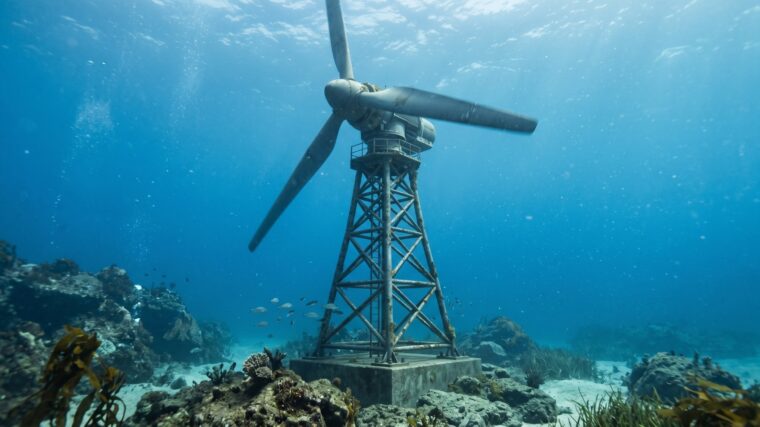
Why tidal turbines matter
The gravitational force between the earth, moon and the sun causes tidal energy. These gravitational forces cause periodic motion of sea water to cause tidal currents which can be used to generate electricity. Tidal currents are very predictable as opposed to wind or solar power. The tidal cycles are predictable years well before they occur with a high level of accuracy, giving grid operators confidence to plan the energy production (Neill et al., 2021).
The density of water is about 800 times that of air. This means that a tidal turbine can produce a considerable amount of power compared to a wind turbine of the same size in less flow velocity. Tidal energy is a promising part of the renewable energy system of the future due to this physical advantage (Novo and Kyozuka, 2021).
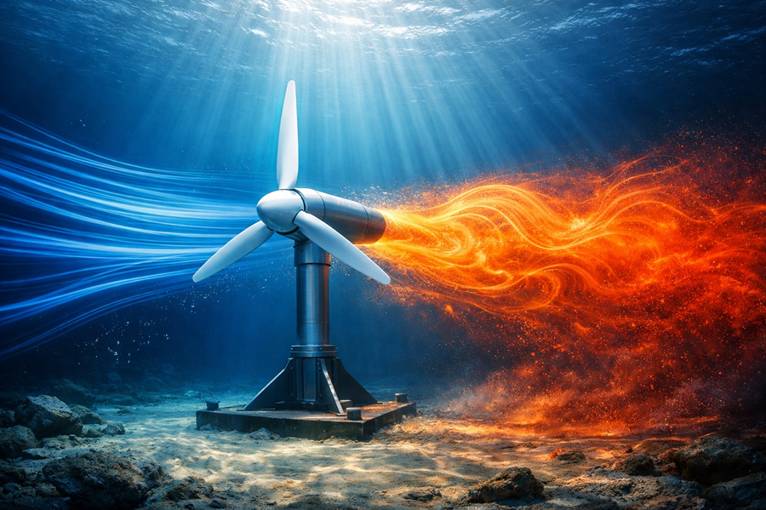
When a turbine extracts energy from moving water, it disturbs the field of flow around. The flow slows down on the way to the rotor. Below the turbine, a region of slowing is created called the wake. Turbulence is high at the wake and can impact downstream turbines in array designs (Khare & Bhuiyan, 2022).
How turbine performance was analyzed
The actuator disc theory (a simplified analytical model) was applied in the study to determine turbine performance parameters, which included power coefficient, thrust coefficient, and wake velocity. In this model, the turbine is modeled as a permeable disc, which takes away momentum in the flow. The disc is uniformly loaded and friction free, and there are no blade geometry or rotational effects (van Kuik, 2020). Such simplifications enable the underlying physics of energy extraction to be studied without the intricacy of full blade-resolved simulations.
The most important parameter in actuator disc theory is the axial induction factor, α. It is the fractional change in velocity of the water flowing through the rotor plane. The value has a range of 0 (no energy is extracted) to 0.5 (theoretical limit where the wake velocity is zero).
The performance of turbines was assessed using three basic equations:
- Power coefficient (efficiency): Cp = 4α(1 – α)2
- Thrust coefficient (structural load): Cr = 4α(1 – α)
- Wake velocity: Vwake = V0(1 – 2α)
The power coefficient, Cp, thrust coefficient, Cr, and wake velocity, Vwake were calculated as a function of axial induction factor, α. The following parameters were taken from the CFD study by Gebreslassie et al. (2012): rotor diameter, 0.20 m; swept area, 0.0314 m²; inlet velocity, 0.746 m/s and the density of the water is 998 kg/m³.
To evaluate the authenticity of the analytical predictions, the results were cross compared with published CFD (Computational Fluid Dynamics) and experimental studies. The comparison was done based on the power coefficient values, wake recovery distances and energy losses reported in the studies by Badoe et al. (2022), Mehmood et al. (2012) and Gebreslassie et al. (2012).
Key findings: Efficiency, thrust, and wake behavior
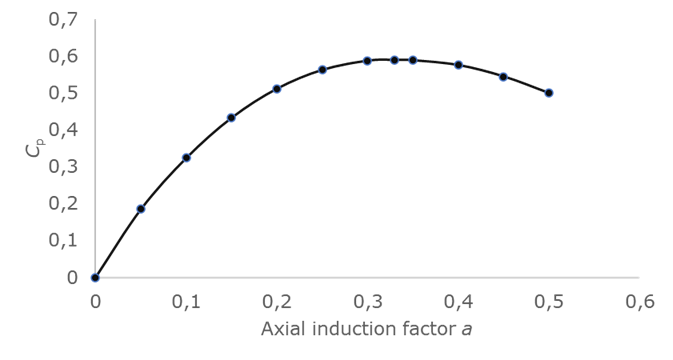
The analytical model was able to recreate the Betz limit with a maximum power coefficient of 0.59 at an axial induction factor of 0.33 (see Figure 2). This is the theoretical ideal efficiency of any turbine in open flow (Bontempo & Manna, 2025). However, real tidal turbines usually have a power coefficient ranging between 0.35 and 0.45 caused by the drag of the blades, turbulence and structural losses (Mehmood et al., 2012). This implies that existing turbines are wasting 24-41 % of the energy that they have the potential to collect.
It was found that the thrust coefficient (the axial force on the turbine structure) would increase with energy extraction. The thrust coefficient is equal to 0.88 at the Betz optimum (α = 0.33). Theoretically (α = 0.5) it is 1.0. Increased thrust implies increased structural loads which should be factored in the foundation and support design.
The model also revealed that the decrease in the wake velocity is linear to the extent of energy liberated. In the Betz optimum, the velocity of the wake is just a third of the flow speed entering. It takes the recovery of the wakes up 10 to 20 rotor diameters to get back to nearly free stream conditions. This is in line with the literature on CFD, in which Gebreslassie et al. (2012) cited that the effect of the wakes continued to 14 diameters downstream.
Power production follows a cubic relationship with flow velocity (P ∝ V³). The power output on doubling velocity between 1 m/s and 2 m/s is eight times greater. This is the basic relationship that makes the site selection very important in tidal energy projects.
What these results tell us about tidal turbines
Wake behavior is crucial when designing tidal turbine arrays. Turbines that are placed in proximity experience poor performance as the inflow velocity is low and the turbulence is high. A turbine that utilizes the flow to generate energy leaves behind a slower wake, which can extend 10-20 rotor diameters down the flow. Any turbine that is placed within this distance will be in slow flow and generate less power. Wake behavior is crucial when designing tidal turbine arrays. Turbines placed too close together suffer reduced performance due to lower inflow velocity and higher turbulence.
The research points to a basic tradeoff between extracting energy and deficit of wakes. The higher the Cp the more the turbine will extract energy and produce a strong wake (reduced wake velocity). This implies that individual efficiency of turbines is increased at the expense of increased downstream device impact. These are some of the competing factors that designers need to consider when designing array layouts. The study highlights the trade-off between energy extraction and wake deficit, offering guidance for array spacing and layout optimization.
This discovery is reinforced by experimental studies. Badoe et al. (2022) calculated a power coefficient of 0.42 with a single turbine, but the coefficient decreased to 0.36 with a turbine in a three-turbine array – which corresponds to a 14 % change in the wake interaction. Zhang et al. (2023) revealed that the closer the turbines are to each other, the greater the interaction losses and the lower the downstream performance.
The cubic relationship between power and flow velocity has practical implications. Any slight increase in current speed increases the available power significantly. Site selection is important as a result – high flow locations such as the Pentland Firth in Scotland or the Channel Islands can have a much higher energy output than low flow locations.
Analytical models and detailed simulations are a complementary pair of tools to design tidal turbines and optimize arrays. Future work should include blade-resolved CFD simulations, turbulence modelling, and experimental validation. Blade-resolved simulations would resolve tips and other three-dimensional flow features unreachable for the actuator disc model. RANS or LES turbulence modelling would give an understanding of the processes of wake mixing and recovery. Model predictions could be experimentally tested in flume tanks or field measurements, under realistic conditions. Combining computational and experimental approaches would provide deeper insight into complex flow structures that analytical models cannot capture.
This article is based on the thesis work done by Ashraful Tamim, and supervised by Dr. Elena Kuisma. The thesis permalink is http://urn.fi/URN:NBN:fi:amk-202605059342.