Molding co-creation concrete
At the Port of Vaasa, advanced collaboration propelled by an innovation ecosystem approach summons different sector actors and various stakeholders together for infrastructure, energy, logistics and service development through co-created innovation. It is not all song and dance, though, since some actors, particularly from the private sector and industry side, consider the ecosystem paradigm rather abstract and somewhat fuzzy compared with familiar project management practices and models, which hit closer to home.
One such model is Stage-Gate®, which structures project progression through defined stages and decision gates for assessing progress and deciding whether and how to proceed (5). This familiar Stage-Gate method of execution could help mold the innovation ecosystem’s collaboration and co-creation into something more concrete for actors used to project management. Its stages and gates would provide a structure for addressing investments, resource commitments and crystal-clear responsibilities for implementing the co-created innovation.
Beyond the project’s end
The responsibilities also need to reflect the different periods for which actors take part within a project, pilot or RDI initiative. Additionally, specialists and contractors selected through a tendering process and working, for example, on infrastructure development, energy solutions or digitalization and ICT are often project based. They contribute only to individual projects, whereas other actors may remain involved in the ecosystem’s continuing operation, development, new projects and pilots for the long haul.
Once a project formally ends, what remains for the ecosystem to build on? The knowledge, capabilities, relationships and solutions it helped develop can and should keep contributing and evolving.
This article proposes combining Stage-Gate and orchestrated co-creation frameworks to aid ecosystem-related actors in implementing projects together and building on the results.
Stage-Gate learns new tricks
Robert G. Cooper developed the Stage-Gate® process to guide, lead and channel product innovation from idea to launch. Stage-Gate was based strongly on earlier phased project planning, including NASA’s 1960s approach (6). They utilized phased planning to structure complex space-mission research and development during the Apollo era. Surely, nobody wants “Houston, we have a problem” to become a regular catchphrase.
Related approaches to project governance use terms such as ‘phase-gate’, ‘phased review’ and ‘tollgate’ (7–9). Customer delivery projects exemplify how the mentioned approaches apply outside product innovation, with phase design depending on project type, governance requirements and risk (9).
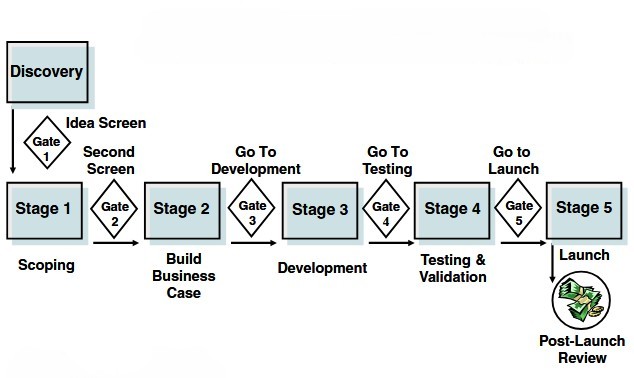
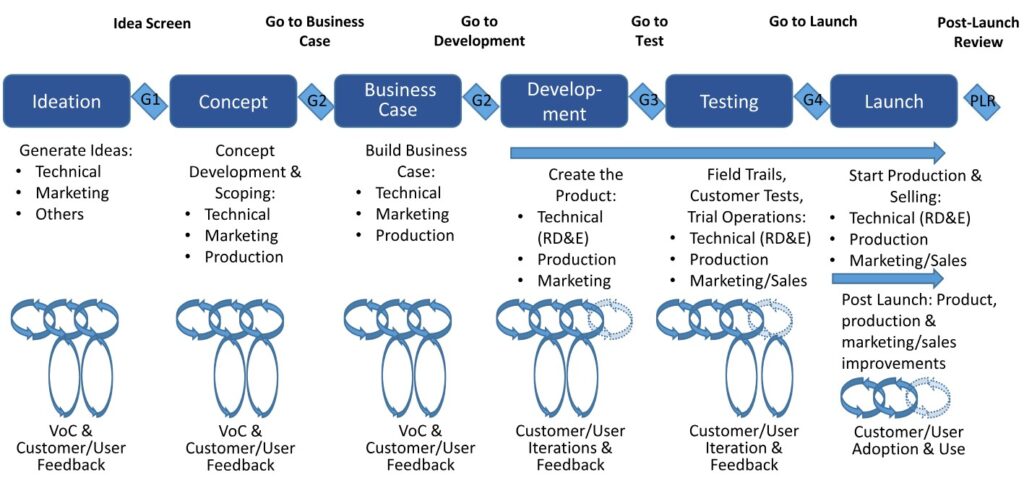
The Stage-Gate process kicks off with ‘discovery’ and is followed by five consecutive stages (Figure 1): ‘scoping’, ‘building the business case’, ‘development’, ‘testing and validation’, and ‘launch’. After this a ‘post-launch review’ follows. Within the stages, cross-functional activities generate evidence for decisions. At the gates, this evidence supports assessments of project viability against agreed criteria, leading to ‘go’, ‘kill’, ‘hold’ or ‘recycle’ decisions. Additionally, a ‘go’ decision commits resources and defines the next stage’s activities (5). Simple and beautiful, progressive and direct.
Room for iteration
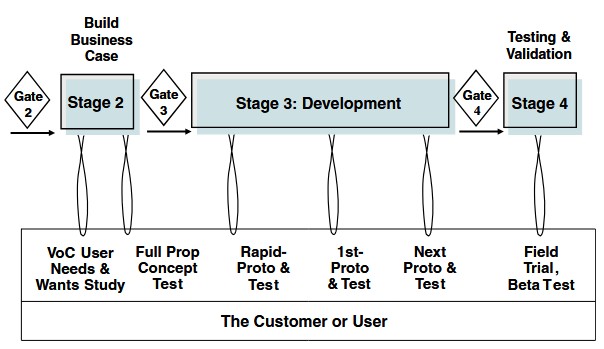
Furthermore, in 1994, Cooper proposed more flexible processes, conditional gates and a stronger project portfolio focus (6). By 2008, further developments included overlapping stages, the option for iterative work, and versions scaled to various project risk factors (Figure 2) (5).
Agile between the gates
In addition, early studies combined Agile methods with Stage-Gate in software projects (10). Furthermore, subsequent research studied this crossbreed in physical product development. The Agile–Stage-Gate hybrid (Figure 3) retains gates for investment decisions and includes short sprints and customer feedback in the stages. Applying these practices to physical products requires adaptations (11).
Innovation ecosystem co-creation in motion
An innovation ecosystem encases heterogeneous, interdependent actors who combine knowledge, resources and capabilities for co-created innovation and value (12,13). Moreover, these actors possess distinct visions, interests and goals, and on top of that, their assumed roles and owned relationships modify and adjust how collaboration and trust within the ecosystem work and develop.
Within this advanced and highly networked collaboration, value co-creation concerns the interactions through which actors develop even-handedly beneficial end-results and generate economic, social and ecological gains. A lot develops and proceeds through piloting and testing, continuous feedback and the iterative refinement of shared objectives and solutions (3).
Four phases, many cycles
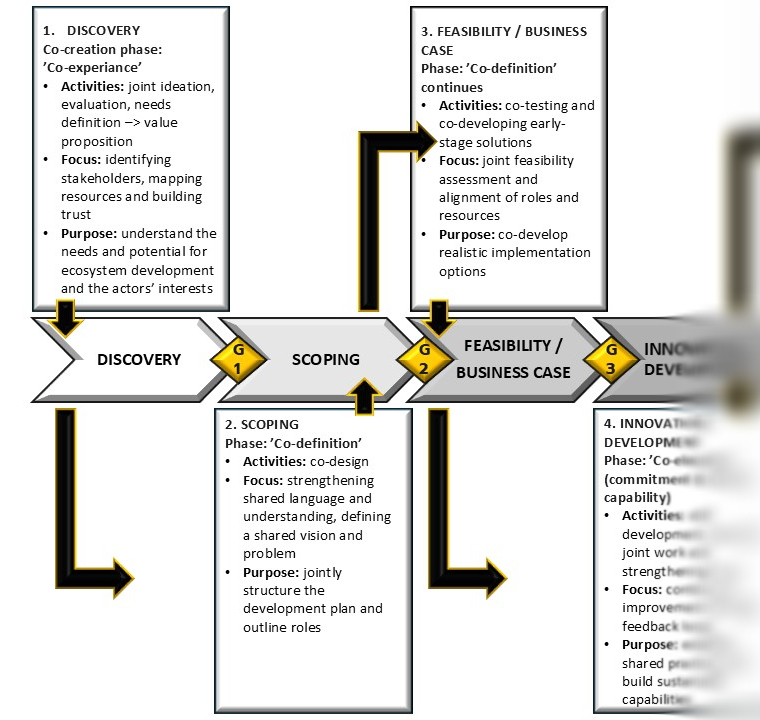
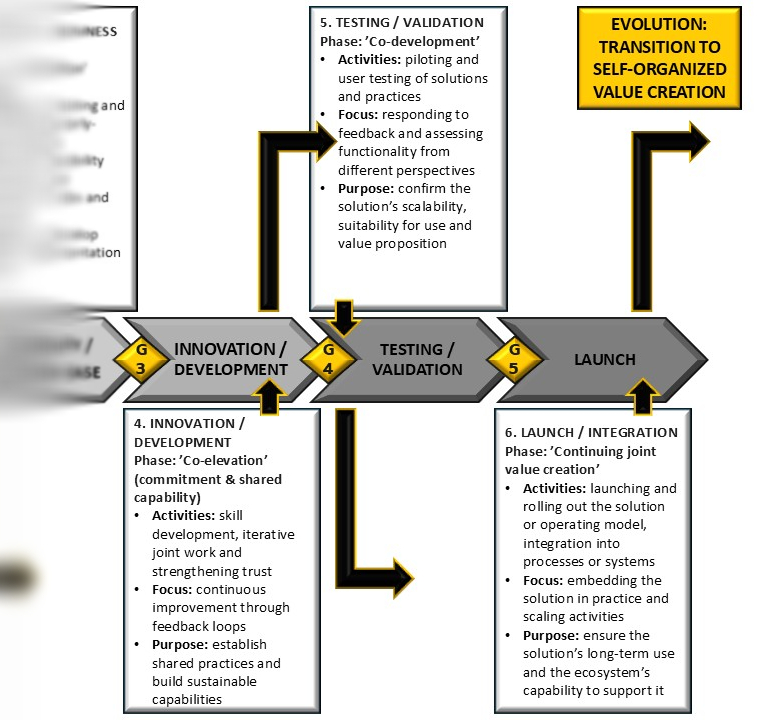
The co-creation and orchestration framework constructed for the case ‘Port of Vaasa’s innovation ecosystem development’ (Figures 4 & 5) distinguishes four interconnected co-creation phases. ‘Co-experience’ involves identifying joint interests and establishing needed relationships. ‘Co-definition’ brings goals, resources, shared ecosystem language and roles into alignment. The following ‘co-elevation’ phase strengthens collaboration even more through open knowledge sharing, skill development and iterative fine-tuning. After this, ‘co-development’ includes prototyping and piloting, implementation, self-reflection and a lessons learned activity. Throughout and within these phases, finger-on-the-pulse feedback and emerging opportunities can inspire actors to revisit the earlier phases or begin another cycle, for instance, with a new project or RDI initiative (14,15).
Orchestration calls for a mandate
Orchestration practices connect the mentioned phases, with targeted activities specifying the work involved. Understandably, interaction capabilities foster this delicate task by enabling actors to better understand needs, boldly take part, initiate innovation, learn together and sustain trust. Furthermore, these capabilities protect and serve fairness in resource sharing, funding and inclusion in collaboration (15,16).
Indeed, innovation ecosystem orchestration in general supports the overall co-creation process by coordinating the ecosystem actors, objectives, resources and investments for innovation and value creation. Furthermore, orchestrators need to establish their legitimacy and trustworthy governance arrangements for ecosystem development and co-creation. Their mandate to lead must be clear and accepted by the participating actors (15–18).
Stage-Gate meets ecosystem co-creation
The proposed integration of the two concepts differentiates project maturity from the ecosystem actors’ capacity to create value together. In the introduced novel framework, gates review the conditions for progression across both dimensions. Project stages and co-creation phases can progress at different speeds. Links between them guide planning. ‘Discovery’ connects with ‘co-experience’ through actor mapping and opportunity identification. ‘Scoping’ relates to ‘co-definition’ as actors acknowledge a shared problem, value proposition and preliminary roles. ‘Business-case development’ continues ‘co-definition’ through joint feasibility assessment of viable options and resource requirements (Figure 4). ‘Development’ connects with ‘co-elevation’ as actors strengthen capabilities and establish working routines. Joint pilots and feedback link ‘testing and validation’ with ‘co-development’. Ultimately, ‘launch’ combines operational integration with arrangements for sustained value creation (Figure 5).
Two dimensions, different speeds
These two dimensions, however, can advance at different rates. A technically straightforward solution may approach ‘development’ on the Stage-Gate model, while ecosystem-related investment ownership or data-sharing arrangements remain unresolved. By contrast, an experienced actor group may possess established collaborative capacity. However, a new solution may still be at the ‘discovery’ phase of the Stage-Gate model. Hence, the project stage alone cannot establish the network’s readiness for joint implementation.
Gate assessments must also check which actors the next stage depends on and whether their roles, commitments and agreements are in place. Feedback is valuable in indicating whether project plans, collaboration arrangements or both need revising. For example, it can happen that actors may need to return to ‘co-definition’ to clarify unresolved roles whilst technical feasibility work continues.
Ready together at the gates
Stage-Gate is based on the idea that evidence guides decisions and resource commitments (5). The proposed novel integration model is based on this. Each gate reviews both project progress and the actors’ ability and commitment to execute the next stage together. The requirements for passing a gate should match the work waiting in that next stage.
Early gates focus on shared understanding, actor roles and feasible options. Before piloting and implementation, reviews should address committed resources, responsibilities, financing options and routes, data arrangements and expected benefits for participating actors. The gate decision then determines whether to proceed, revise, hold or stop the initiative. Additionally, it specifies the conditions for the initiative’s next step.
Regular checks should reveal whether the actors can do the agreed work – talk the talk and walk the walk. Moreover, checkups should indicate whether each project runs as planned and delivers the expected value. This information aids gate decisions.
Life beyond launch
Funding and handover
Implementing a co-created solution calls for clarity about funding for development and pilots, as well as the investment needed to launch the solution in question. Value capture relates to the benefits each participating actor gains from that solution. Agreements come into play in specifying investment owners, capital and operating cost responsibilities, risk sharing and financing for continued operation.
Participation naturally changes as initiatives move forward. Specialist contractors may break away after project delivery; however, ecosystem-devoted actors, asset owners and service providers may retain or be interested in continuing roles. The project team should hand over the co-created solution to the actors responsible for its continued operation. In this, documentation is needed. The same goes for knowledge transfer, system access and agreed maintenance responsibilities.
What the project leaves behind
Stage-Gate’s ‘post-launch review’ contributes to accountability and learning (5). Moreover, in the presented new model, the review scrutinizes which outputs, knowledge, data, standards, relationships and resources can remain available to support the ecosystem’s ongoing activities and future projects. In addition, it should evaluate whose expected benefits have been concretised and identify pending needs. Kept assets and operational feedback should help choose and plan future initiatives. Actors should agree on who can gain access to the knowledge and who will store and guard it. This accord should ensure that the knowledge is available even if the initiative ends or expires.
Preparing the next cycle
Collaboration needs tending and care after project funding ends. The actors should see eye to eye on who assumes this crucial role and ensure that the needed resources are available. The selected actor or team keeps the other actors working together, organizes participation and orchestrates priorities, funding and resource commitments across projects running in parallel. Likewise important is to prepare the next development steps. As actors join, leave or return, consensus on who leads this work must hold and be honoured.
Back to square one?
Don’t be a square! For each new or returning initiative, the actors must decide which Stage-Gate® stage and co-creation phase to start from. Whether the actors and technology are familiar and whether the initiative fits the ecosystem’s goals affect this decision. Additional influencing issues are e.g., investment needs, data and security requirements, and links to other initiatives.
Familiar actors, known technology and a shared objective may allow work to begin at ‘scoping’ or ‘feasibility’. Evidence and agreements from earlier work must still meet the relevant gate criteria. New actors, uncertain technologies, changed objectives or major investments may instead require a return to ‘co-experience’ or ‘co-definition’. While continued operation maintains the launched solution, renewal involves identifying new needs, actors and development opportunities. Further paths include scaling, replication, new initiatives or discontinuation.
Managers and orchestrators can use the presented framework to check and ensure partners’ ability and commitment to implement together. Furthermore, it assists them plan how useful project results will support future ecosystem initiatives.
Project information
Project: Satama puhtaan siirtymän innovaatioalustana
Duration: 1 February 2025–31 July 2027
Lead organization: Vaasan Satamapalvelut Oy
Project partners: Vaasa University of Applied Sciences (VAMK) and Vaasa Region Development Company VASEK
Funding: Co-funded by the European Union
Total budget: €244,489