Introduction
The demand to travel with pets by plane is increasing as pets are seen either as companions or family members. However, the aviation industry cannot meet the demand and needs of pet owners. Before travelling with their pets, most need to navigate complex airline pet policies and pay higher fees. Moreover, many airlines require larger pets to travel in cargo holds originally designed for carrying baggage, and which, according to most experts, could be dangerous and unsafe.
This research uses mixed methods research to explore the growing trend of pets’ travel and the business opportunities it presents. The result suggests that most respondents prefer to travel with their pet in the cabin even if they need to pay an additional fee.
A clear demand for domestic animal travel
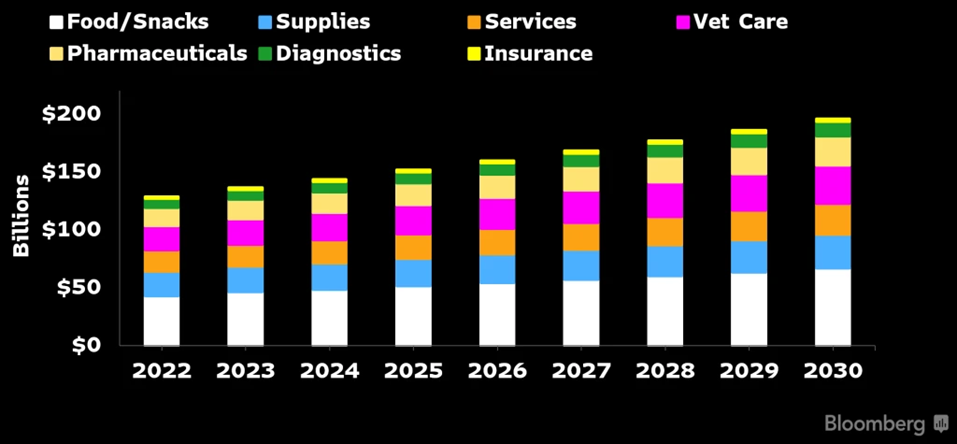
The global pet industry continues to grow at a 6,58 % annual rate and is expected to exceed 465 billion euros (USD $500 billion) by 2030 (Bloomberg, 2023). Figure 1 shows the Pet Industry Growth projected by 2030 for the United States of America. The growth in the pet industry in general is the result of a deeper phenomenon, including the redefinition of the family model, housing crisis, high rates of unemployment, and a decrease in newborns (Rosero-Pena Diana, & Kirk Ann-Hunter van, 2024). Services in pet nutrition, insurance, veterinary services, and even accommodation have increased because of the human-animal bond. Because of this bond, studies suggest that consumers are even ready to pay for premium care and service for their domestic animals (Forbes, 2018; Lue et al., 2008).
According to the International Air Transport Association (IATA), airlines only differentiate between two service categories: passengers and baggage (IATA, 1999). Yet, in many EU countries, pets are no longer considered mere property. They are recognised as “sentient beings” in France, Belgium, the Netherlands, Sweden, Finland, etc., and “not as objects or things” in Switzerland, Austria, and Germany (Animal Protection Index, 2019). They are also viewed to have “intrinsic value” in Norway and as legal “family members” in Spain (BOE, 2022). Despite these legal considerations, pets are still considered in aviation regulations as baggage (CJEU, 2025). According to Jahn et al, aviation currently lacks rules that genuinely promote animal welfare and the demands of families with pets, despite the increase in pet ownership (Jahn et al., 2023).
Methodology and Results
A quantitative survey of 105 respondents was analysed along with qualitative interviews from 10 experts, professionals, and aviation stakeholders. Secondary data from 711 respondents is also used to get more insight into the topic.
The result of the research from the 105 respondents clearly indicates a gap between how the aviation industry operates and what the customers want. 84% of pet owners are willing to travel with their pets in the cabin if allowed to do so. 58% avoid doing so because of safety, stress, and ethical considerations that come with in-cargo pet travel. Pet owners face difficulties due to unclear communication from the airlines, combined with restrictive pet travel policies, creating inconsistent experiences. The primary concerns about pet safety and stress in cargo operations stem from documented cases of animal injuries and, in the worst-case scenario, deaths and other permanent injuries during transport.
Apart from the above-mentioned consumer demand and worries, interviewed airline staff members identified operational problems and regulatory barriers, and liability issues as the primary obstacles to implementing changes. The current international regulations prioritise logistical operations instead of animal welfare and customer satisfaction, as each airline operates independently to create its pet policies, which result in inconsistent service delivery and decreasing customer trust.
Additionally, the result mentions the untapped pet-friendly market potential with an estimated total addressable market (TAM) of 30 billion euros annually in Europe alone. The demand curve from the respondents shows how sensitive they are to the amount of money they are willing to pay if allowed to travel in-cabin with their pets. All respondents are willing to pay around 200 euros per pet travel for short distances. But this demand drops to 50% at 225 euros and falls below 10% for 375 euros per pet travel.
The analysis of the interviews with experts reveals that they support the idea of introducing pet-friendly cabin zones. They propose that international air travel organisations like ICAO and IATA should set global standards and improve regulations for in-cabin pet travel.
Discussion & Recommendations
This research pinpoints a clear gap between a growing demand for pet travel, with an also increasing demand for air travel (preferably in-cabin, especially for dogs and cats, despite their size), and the limited options currently provided by airlines. The results of a case study of a short-haul flight draw attention to pet owners’ willingness to pay around 200 euros to be able to travel in-cabin with their pets. Whereas current regulations remain a barrier, passengers who had a good experience with travelling with their pets are willing to do so again. This suggests a deeper shift in how society views domestic animals and how airline companies can accommodate them.
The study recommends a change of regulation and in existing infrastructures as follows:
- Redesigning cabin and operations: rethink the design of planes to include pet-friendly seating zones with extra space and safety. Also, another option is to offer pet-friendly flights on specific schedules and routes. For example, airlines could designate certain popular routes at very early or very late times as pet-friendly and clearly label them as such. This would allow passengers to choose whether they want to book these flights, while also addressing concerns of travellers with allergies or those who prefer not to fly alongside pets.
- Pet travel pricing strategies: Having a pricing strategy that includes extra charges, as far as pet owners are allowed to travel in-cabin with their pets. Similar strategies are adopted by some charter operator including Bark Air (USD 8,000 per passenger with a pet) and RetrievAir (approx. USD 700) (BARK Air, 2025; RetrievAir, 2025).
- Set up Global pet-friendly travel Standards and Regulations: working with aviation bodies like ICAO and IATA. A working paper published by the International Civil Aviation Organization (ICAO) gives the example of Colombia about setting up global rules and regulations for pet travel to solve the current challenges (ICAO, 2025).
- Training aviation staff: providing adequate training to the airport ground holding and airplane crew, as well as aviation staff in general, to improve security.
Conclusion
This study shows how flying with domestic animals presents both challenges and opportunities. Whereas pet owners are willing to travel with their pet in-cabin if given the opportunity, barriers including airline policies, elevated cost, and lack of global standards remain a barrier. The research highlights the business opportunity and business opportunities if accommodating pet-inclusive travel in the entire ecosystem of airlines and airports. Additionally, affordable in-cabin cost, plane and operational design innovation, and staff training could improve the pet travel experience.