
Introduction
The role of Project Management (PM) has been to offer good results while focusing on cost, resources, and timely delivery. Due to growing pressures from scarcity of resources, socio-environmental challenges, and governmental regulatory pressures, projects need to be managed in a sustainable way. Furthermore, emerging tools such as Artificial Intelligence (AI) represent opportunities in enhancing project decision-making and predictive capabilities. However, there is limited empirical evidence on the perception of AI and its adoption by PM professionals. This article aims to use quantitative survey data collected from 73 project management professionals and students to investigate the relationship between the adoption of AI on one side and AI tool utilization and future expectations of AI on the other side.
Literature Review
Silvius et al. (2014) define sustainable Project Management as a method to manage projects for maximum economic value with little impact on the environment. Prior research highlights the role emerging technologies, in general, and AI in particular, are playing in the efficient management of projects. These tools help automate many routine tasks, predict outcomes, and support decision-making. Predictive analytics support project managers in lowering both carbon emissions and waste during project planning and execution (Chen et al., 2020). Goh and Vinuesa recommend an AI-Integrated Sustainability Decision Support System needed for all stages of the project to ensure sustainability. Their research shows how AI technology in Sustainable Construction Project Frameworks helps project managers meet environmental rules and improve project sustainability (Goh & Vinuesa, 2021).
According to established theories, the adoption of new technology is influenced mostly by many factors, including awareness, perceived usefulness, ease of use, and organizational support (Davis, 1989; Venkatesh et al., 2003). However, other considerations like ethical concerns, data availability, trust, and biases need to be considered when emerging technology such as AI is adopted (Memarian & Doleck, 2023).
Research Design
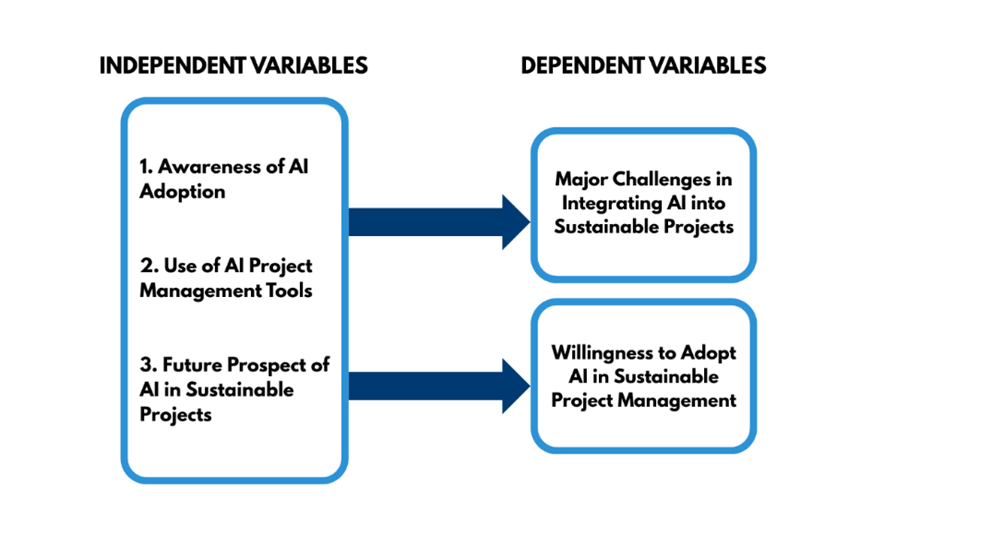
A study using data from 73 professionals in IT, healthcare, education, and construction was conducted. Respondents were project managers, consultants, engineers, and PM students. The data is analyzed using SPSS, with descriptive statistics, tests of reliability, and regression and correlation analysis to find the connections between variables. Figure 1 provides a research framework that aims to study the relationship between independent and dependent variables. The framework explores the influence of independent factors, such as Awareness of AI Adoption, Use of AI Project Management Tools, and Future Prospect of AI, on the dependent factors, including perceived challenges and willingness to adopt AI in organizations.
Empirical Findings
The data collected showed that most of the respondents were early-to-mid-career professionals. 85% aged 26 – 45-year-old whereas 87% held a bachelor’s degree (See Table 1).
| Variable | Options | Frequency | Percent |
|---|---|---|---|
| Age group | 18-25 26-35 36-45 46-55 | 7 33 29 4 | 9,6 45,2 39,7 5,5 |
| Level of education | Bachelor’s degree High school diploma Master’s degree | 31 9 33 | 42,5 12,3 45,2 |
| Industry | Construction Education Finance Healthcare IT & Software Development Manufacturing | 5 9 10 20 22 7 | 6,8 12,3 13,7 27,4 30,1 9,6 |
| Role | Consultant Engineer Other Project Manager Researcher/Academic Team Lead | 14 8 2 13 18 18 | 19,2 11,0 2,7 17,8 24,7 24,7 |
| Experience | 1-3 years 4-7 years 8-10 years Less than 1 year More than 10 years | 22 10 7 19 15 | 30,1 13,7 9,6 26,0 20,5 |
The reliability analysis shows high internal consistency (more than 0,70) for all independent variables (see Table 2), confirming that the survey data is reliable and measures the intended constructs (Hair, 2009).
| Variable | Cornbach’s alpha |
|---|---|
| Awareness_Adoption | .821 |
| AI_Project_Management | .883 |
| Future_Prospect | .899 |
Correlation and regression analysis provide deeper insight into the phenomenon under investigation. The regression analysis indicates that awareness of AI adoption was not a statistically significant predictor of adoption willingness (B = −0.478, β = −0.383, p = .175). This suggests that awareness alone is not a determining factor in adopting AI. However, there is a strong positive strong correlation between the AI project management tools and the Willingness to adopt AI (r = 0.821, p < .01). Future prospect also correlates strongly with Willingness to adopt AI (r = 0.822, p < .01). This suggests that those having an optimist view on the future of AI are likely willing to adopt it.Perceived challenges faced tend to increase with experience and awareness, but do not discourage their adoption. Analysis of these findings suggests that the adoption of AI in sustainable project management is mainly driven by experience rather than awareness alone.
Discussion & Recommendations
The empirical result reveals a distinction between awareness of AI and practical readiness for its adoption and usage. Most of the respondents acknowledge the important role AI plays in achieving sustainability in projects. However, they recognise that its adoption depends mainly on experience and perceived usefulness. Respondents who are familiar with AI-based Project management tools have a greater willingness to integrate them in sustainable PM. This suggests that AI tools are seen not as mere technological add-ons, but as enablers of an AI-driven sustainable project management framework. Future expectation is also considered to lower the foreseen barriers to AI adoption. Respondents who think that in the long run AI will become an integral part of business processes and PM are more ready to accept barriers, including cost, data availability, and integration challenges.
This research provides practical implications and recommendations for organisations willing to integrate AI into sustainable PM. Organisations willing to adopt AI should not just create awareness but rather take practical hands-on implementation steps, such as small-scale pilot projects or AI tool-based training. Promoting a constructive and future-oriented narrative around AI by means of workshops can help lower resistance to its adoption.
Conclusion
This study examined the connection between the usage of AI and its adoption willingness in the context of sustainable project management. The findings showed that the willingness to adopt AI is closely associated with expectations regarding future outcomes, and hands-on engagement with AI tools rather than just creating awareness. The study recommends that organisations willing to integrate AI into their PM processes should go beyond just raising awareness but rather prioritise future-oriented strategy and training.